The Problem
My project centered on one question: where are cardmembers experiencing friction in call servicing, and what can be done about it?
I was scoped to a defined customer segment and given meaningful independence to figure out where to dig first.
Exploration
I started by getting close to the work — listening to calls, mapping out processes, and talking with senior colleagues who understood the servicing ecosystem from the inside.
Those conversations did something data alone couldn't: they helped me understand the structural conditions that had produced certain inefficiencies. That context let me flag problems early, and later helped me rationalize why other gaps existed — which shaped how I approached solutions.
My midpoint presentation captured these qualitative findings and set the roadmap for what came next.
[VISUAL SUGGESTION: A simple phase diagram here — qualitative discovery → quantitative validation → solution design — would make the project arc immediately legible]
Analysis
In the back half of the internship, I learned SQL to examine servicing trends at scale. The goal: validate what I'd observed qualitatively, surface new patterns, and separate signal from noise.
Some leads didn't pan out. Others pointed clearly to high-volume improvement opportunities with real, measurable upside.
Solutions
At a company as large and regulated as American Express, solutions have to be practical — scoped around actual constraints on budget, labor, and implementation timelines.
My recommendations targeted the highest-impact servicing gaps I'd identified. By the end of the summer, I had delivered a set of changes that improved handling efficiency, streamlined servicing workflows, and improved consistency across global call centers — contributing to efficiency gains across millions of annual calls.
Reflection
Ten weeks in Global Servicing taught me things I wouldn't have learned anywhere flashier. The team operates 24/7, 365, across millions of customer interactions — and the commitment to consistency at that scale is something you have to see up close to fully appreciate.
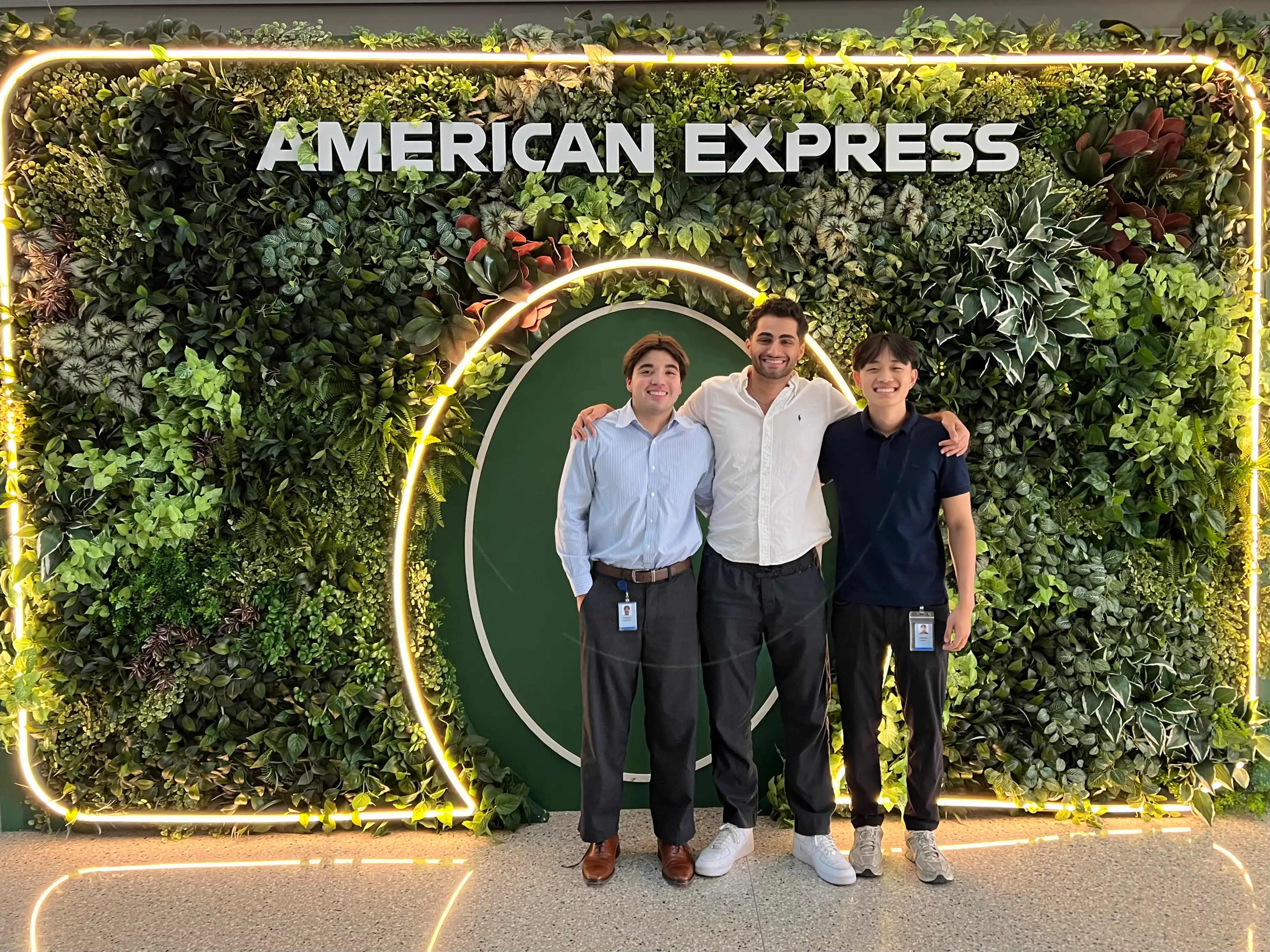
AMEX's Phoenix-based 2026 Industrial Engineering summer interns (from left to right: Franco Cachay, Firas Elshaer, Josh Chon).
I'm taking a few things with me: what it looks like to move fast when given real autonomy, how curiosity opens doors in both project work and relationships, and how to stay oriented when priorities shift mid-stream.
AMEX was a company I respected long before I got there. I left with a clearer sense of why.
Thank you to Andrew, Jake, Marc, Cassie, and Amber — and to the many colleagues who made the summer what it was.