In September 2024, I joined The Browser Company's inaugural School of Browser cohort — 50 campus ambassadors nationwide, selected from over 875 applications. At the time, The Browser Company had one flagship product, Arc.
Problem
In a world of Safari's and Chrome's, Arc redefined integral browser features (like most notably, the vertical tabs) and offered a ton of power features. While beloved by many, Arc's user base was still relatively small. So as ambassadors, our goal was focused on acquiring new student users; they already made up a significant share of Arc's user base, and were some of the most likely to adopt — and use — the unique features that Arc boasted.
Progress with Arc
We wanted to answer the "what is Arc?" and "why should I use it?" questions.
Strategies varied by school, but I generally decided to focus on digital and social channels to build product awareness, and later in the year, focus on in-person events and marketing. I also relied on existing clubs and organizations to show product demos to, and by December, UCLA was leading the downloads chart.
Pivot
Around late October, The Browser Company had publicly announced their development of a new product without many details. By December, however, ambassadors were told we would be among the first to help pilot it.
January brought exciting changes to the School of Browser program, and, in a nutshell, our focus quickly pivoted to the new product, Dia.
Why? Josh Miller's recent letter captures it best, but Arc's growth became essentially anchored by its "novelty tax." We ambassadors had realized it too. Arc is a lot — great for those who take the time to learn its power features, not as great for someone with no idea of what Arc was. So while Arc wasn't going anywhere, Dia offered a fresh (redesigned) start.
Dia Phase I
Dia became a promise of AI built into the interface that we already use daily — our browser. Students around the world became vital to building out that vision.
The Browser Company wanted to nail down an MVP for students first, and focus on other user types later. As ambassadors, we began collecting research as fast as we could. Interviews with students helped gather hundreds of insights as to how students perceive AI — their fears, their doubts, and what they wished it could do. Focus groups also helped us learn more about what it would take to build a product that works.
Around the same time, I was preparing to host Bruin Tank, a startup pitch competition. Hoping to receive financial sponsorship, I pitched Bruin Tank as a place to promote The Browser Company. To my surprise, the team agreed to instead make it Dia's first-ever public touch point. So, in a matter of just three weeks and with an all-too-early MVP, we raced to assemble Dia's first product messaging, branding, and launch strategy. Luckily, the sprint paid off — we reached nearly 200 people who showed interest.
Dia's first-ever public touchpoint at Bruin Tank 2025: tabling included myriads of merch, interest form sign-ups, and product concept information.
Dia Phase II
This is where things get really interesting (and move very, very quickly). In early Spring, Dia's doors were wide open for students. To amp things up, students in the Alpha Testers Slack were invited to participate in a fierce competition for referred campus downloads, complete with marketing collaterals, funding, and a messaging strategy that made Dia 'your next study partner' on campus.
So I put Dia everywhere. Posters on bulletin boards, promo material across dozens of social channels, demos at clubs/organizations, and the infamous Bruin Walk flyering (if you know, you know). But I also knew that UCLA had an edge on most other schools, and that it was an ideal hub for massive growth — thousands of students, strong entrepreneurship and startup culture (i.e., students like trying and building new products), students who enjoy free things (who doesn't?), and a large campus presence. So I sought bolder ways to acquire new users.
With the support of the Browser Co team, I hosted an "Open Tab" event where students would come, learn about Dia and download it, and get a free coffee of their choice, courtesy of our running open tab.
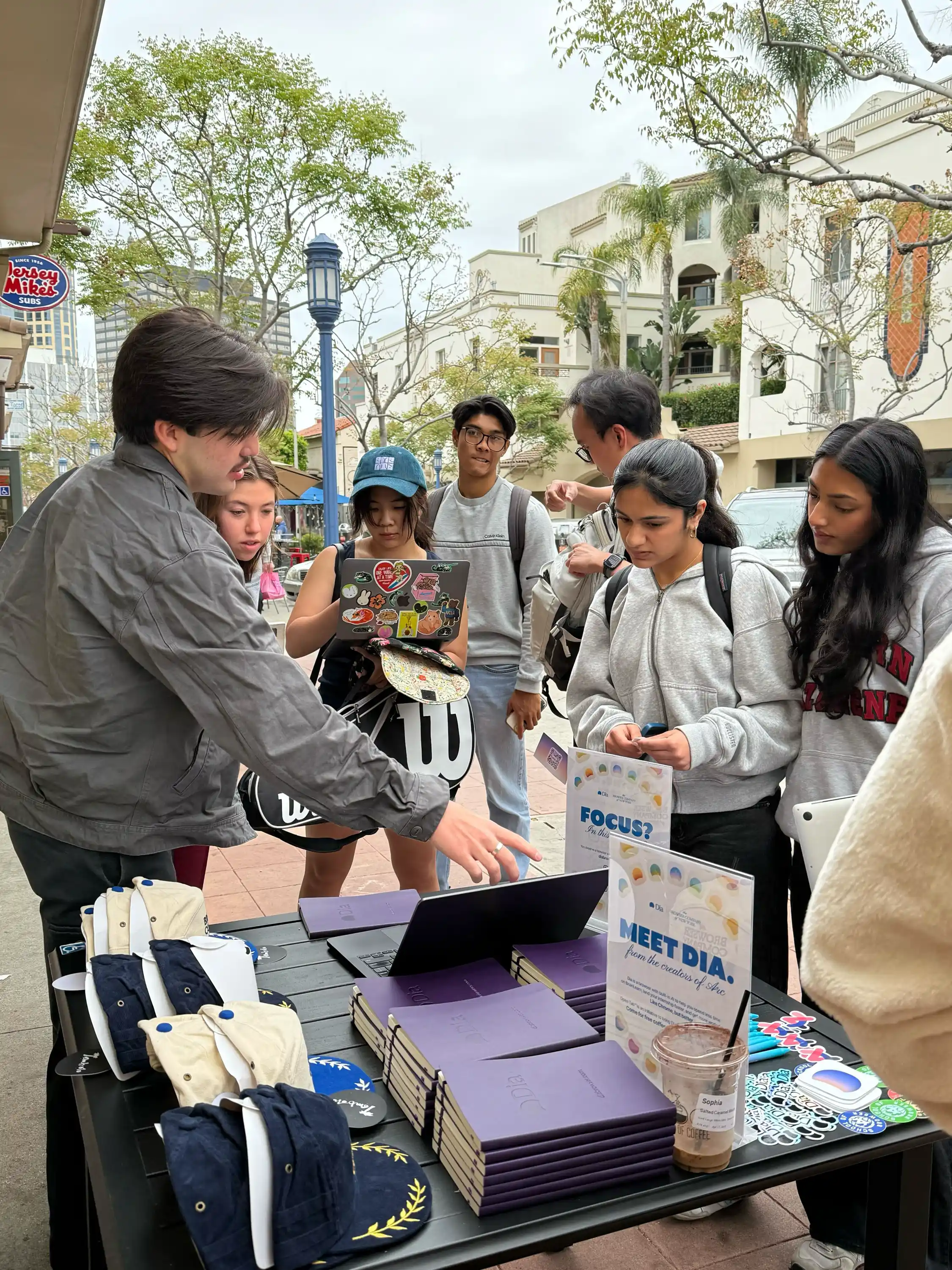
Presenting a live demo of Dia's student-centered use cases at UCLA's first Open Tab™ event (featuring Josh Miller and Devin Lewtan).
The event was a major hit. Over 100 students showed up, and we were joined by Josh, the company's CEO.
Throughout the rest of the school year, the pattern continued — employing dozens of new guerrilla campus strategies, hosting new events, and showing Dia to as many students as possible. By June, I received recognition as being among the top 4 ambassadors globally.
Reflection
Being part of School of Browser meant front-row seats to a company actively rethinking what a browser should be — and figuring out how to get people to care. That tension between a genuinely great product and the challenge of getting people to try it is one I'll carry into whatever I build next.
Major thanks to Devin Lewtan — the architect of School of Browser — and the entire Browser Co team.