I've been in competitive gymnastics since I was six — coaching was the obvious next step. I spent three summers at Gyminny Kids in San Diego leading camps for kids aged 3–13, and grew curious about how the business actually ran. That's when I noticed a major friction point.
Problem
Summer brought booming camp registrations. Great for business, tough for staff. One of the biggest bottlenecks I noticed was camp grouping: the process of manually sorting nearly 200 students into groups based on age, gender, friend requests, and other criteria. Managers spent up to three hours on this task every day — time they couldn't spend on more important work.
Solution Planning
Luckily, the process was formulaic. The same factors were weighed every time, and in the same way. That meant an algorithm could do the work.
I started by mapping the existing workflow: which tools did the gym already use, which integrations were possible, and what edge cases needed to be considered. Two constraints shaped my direction quickly. First, integration with iClass Pro — the gym's central management software — was non-negotiable. Second, data sensitivity around student and parent information ruled out certain third-party tools entirely.
Building
I determined that a custom automation was the right call, and took it on independently — outside the scope of my coaching role.
Before building, I sat down with the gym's leadership to map the exact logic: how the algorithm should weigh different criteria, and what the output needed to look like for staff to actually use it without friction.
Deployment
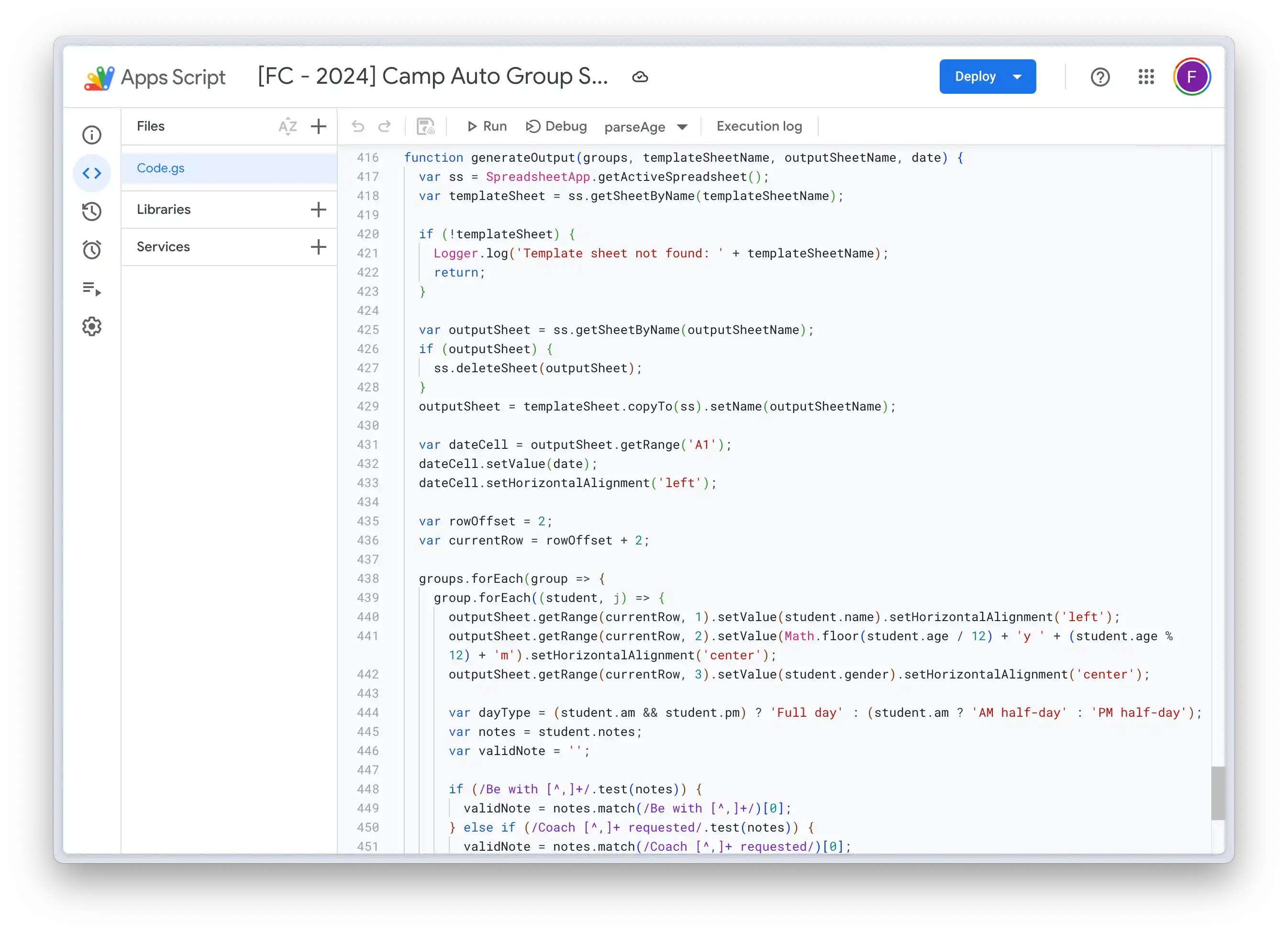
After several refinements and extensive testing, I presented a working solution: a JavaScript automation built with Google Apps Script, integrated directly into the gym's existing student enrollment files. Because those files were already synced with iClass Pro, nothing about the workflow felt unfamiliar to staff. With a single click, they could sort students and generate a master camp-groups document that matched the format they already used daily.
I wrote documentation for the managers running it, then handed it off. The script was piloted at Gyminny Kids' primary location, with plans to expand once it proved effective.
Reflection
Ultimately, the tool itself was straightforward. In retrospect, what I believe mattered more was the instinct behind it — noticing a problem that wasn't mine to solve and deciding to solve it anyway. Despite having left the company, that tendency has followed me into everything since.